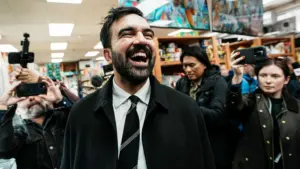
He’s done it. The «dangerous communist,» the «Jew-hater,» the man who «will destroy New York» (as per definition of Donald Trump), and a Muslim on top of that, is the new mayor of New York.
The entire world is now discussing it. Or at least the entire Western world.
Trump and his supporters are furious; the center-left, from the old guard of the American Democratic Party to the Italian organ of the «Left for Israel,» aka «la Repubblica,» are very cautious. According to them, «Generation Z» is the winner. They are very concerned about voters’ expectations for Mamdani, which is why they are focusing on his young age, something the skilled new mayor also emphasized in his inauguration speech.
But it’s not a matter of age. The fact is that for 26 years, since the days of the Anti-Globalization movement (November 30-December 1, 1999) in Seattle — with the siege of the WTO headquarters and the ensuing street battle with the police — the United States has been the scene of waves of increasingly radical social and political movements. These movements — the most powerful of which has been Black Lives Matter, which erupted in late May 2020 — have expressed, along with a resurgence of labor union struggles, the profound discontent and anger of vast sectors of the US proletariat, and the need for a new phase in American political life, calling for the emergence of new political representations.
Since there is currently no revolutionary situation either in the United States or in the rest of the Western world, it was inevitable that new political representations would arise within the Democratic and Republican parties. In the latter, Trumpism was born and established, its political goal being to generate a profound split within the American proletariat to be achieved via a violent clash between sectors of the exasperated and decadent white proletariat and the mass of immigrant proletarians and minorities of color, whom Trump and his gang branded as the scapegoat for America’s decline. Within the Democratic Party, on the other hand, the Sanders and DSA (Democratic Socialists of America) camp emerged with the goal of defusing the discontent and anger of tens and tens of millions of proletarians oppressed by racism, by the extortionate increase of inflation, and bogged in neverending precariousness, channeling it into electoral games—; an aim to be reached through the denunciation of capitalist oligarchies and by the implementation of social policy programs of a certain audacity, given the times.
Mamdani is the product of these dynamics of rekindling class struggle in the United States, an inevitable consequence of the increasing class polarization, itself caused by the long-term decline of Yankee super-imperialism. And he presents himself with a radical reformist approach and a boldness that place him far beyond Barack Obama. In his inauguration speech, he successfully lashed out at Trump, ridiculing him («I know you’re watching, so I have a few words for you: turn up the volume») and challenging him — the same Trump before whom European heads of state and prime ministers crawl like worms.
Hence the concern of the major corporations who have tried to stop him, and the recurring accusations of «communism,» «Marxism,» anti-Zionism, and «friendship with Hamas.»
These are obvious propaganda exaggerations by Trump and his Zionist cliques, as we explained last July in an article written immediately after Mamdani’s victory in the Democratic Party primaries. But this event remains of great interest to us, precisely because it measures the gradual maturation of a class conflict between the two Americas that will be difficult for the ruling class across the Atlantic to defuse. Trump and his clique of Big Tech oligarchs intend to quell it by invoking a state of emergency, but — as we saw on October 18th — it won’t be a walk in the park for them. Quite the opposite.
It has to be noted that the number of voters has doubled compared to four years ago, rising to over two million. The narrow-minded abstentionist will see only deception in this. We, who prefer dialectics, while considering Sanders, Ocasio Cortes, and Mamdani to be inconsistent demagogues, see this as a possible step forward if the vote isn’t followed by a passive, wait-and-see «homecoming,» but rather by pressure on the newly elected mayor to follow through on promises. And action can’t follow without attacking — to one degree or another — the interests of big financial, real estate, and commercial capital.
Let’s leave it to others (in Italy) to rub their hands in the hope that, thanks to the imitation effect, they might also achieve something more than 1% in the next political elections. These unrepentant election-worshippers forget that in Italy, over the last 25 years, with the exception of isolated moments of struggle, there hasn’t been a dynamic of class conflict and a development of social movements remotely comparable to that of the United States. And when something lively has emerged, the prospect of the absurd self-sufficiency of partial or local movements has favored its decline or disappearance. Likewise, we leave others to dream, in the Mamdani wave, of conquering seats in town councils within a broad center-left coalition – as was the case in the USB election campaign for the unforgettable Five Star Movement mayor of Rome, Virginia Raggi (*).
We, who have much bigger ambitions than these, truly welcome this good news coming from New York. But for entirely different reasons. We expressed these reasons a few months ago, when Mamdani won the primaries of the Democratic Party (see below).
November, 5th
(*) The USB is a «grassroots» union linked to the Stalinist and Kampist organization Rete dei comunisti (Network of Communists).
You can say anything about Trump, and rightly so: a professional liar, a space-age bulshitter, a blackmailer like few others, a first-rate gangster, etc., but you can’t say he lacks political acumen. So there’s a reason why he reacted to Zohran Mamdani’s victory in the New York Democratic primaries by saying «We don’t need a communist running New York,» quickly following his words with threats to cut off all federal funding to the city and deport him (Mamdani being born in Uganda and a naturalized US citizen).
The reason isn’t hard to identify for those of us who have always seen the United States as two distinct «Americas»: one we prefer to spell with a k (Amerika) because, regardless of its membership, whether Democratic or Republican, it makes little or no difference, it is the most ruthless form of class, racial, and sexual domination in the world (well described, among others, by Angela Davis); the other, which we consider our America (or our part of the United States, to be more precise), and it is the vast world of the exploited and oppressed masses, white, black, and recent immigrants from South America and the four corners of the world, from whom — even if a huge number of them are still poisoned by chauvinism — we expect great things.
That which to us is expectation or hope, for Trump and his followers is worry and fear. How dare the Democratic voters, these «lunatic communists,» torpedo the candidacy of Andrew Cuomo, a corrupt friend of powerful New York property developers and the all-powerful Zionist lobbies, by allowing a Palestinian supporter to win? The White House boss smells something fishy in the air. And in a country with a historic, virulent anti-communism, the old alarm bells immediately sound.
There’s not even a hint of communism in Mamdani. But precisely for this reason, it’s worth examining the circumstances of his investiture. It can be explained by three factors: the widespread social unrest in the metropolis, due to the skyrocketing cost of living and the lack of services accessible to those on low-to-medium-incomes, and a combination of material and psychological hardships felt by a large segment of society, including the white population; the radical nature of the remedies proposed by Mamdani, a member of the DSA (Democratic Socialists of America), to address this unrest; and the discredit, or lack of credibility, of other candidates, or potential ones (former governor Cuomo, outgoing mayor Adams, and Lander, a right-wing DSA defector, also a longtime politician).
Let’s be clear: Mamdani is young (33), smart, and brilliant. He has — as they say — charisma. He’s quick-witted and sharp enough. He has excellent communication skills, as a comedian and entertainer, a former band member. But no matter how infantilized the voting public in the United States, primaries are still selectively screened for information and general political knowledge. He also had the triple handicap, no small feat even in a Democratic context, of being of Indian origin (with an immigrant background), a practicing Muslim, and a pro-Palestinian (albeit moderate).
In short, the decisive weight of this surprise result is attributable less to the specific characteristics of the individual than to the economic and social context and his proposals. In New York, the city dominated by financial and real estate capital, the city with the highest cost of living in the United States, poverty has been steadily rising for years. One in four people is unable to meet their basic needs (housing and food). Homelessness is on the rise, with 2024 set to reach a historic record. At least one hundred thousand recent immigrants are experiencing severe material hardship, genuine deprivation, and lack access to public schools, legal assistance, and healthcare. Psychological distress among young people is so widespread and acute that the city has filed a lawsuit against the major social media platforms (TikTok, Facebook, Instagram, Snapchat, YouTube), accusing them of being at the root of these growing disorders and responsible for the public expenditures necessary to contain or cure them. But New York is also a metropolis where even small businesses are permanently at risk, due to the level of taxation, high rents, economic fluctuations, and the extent of poverty. Last November, the New York Weekly asked: «Can small businesses [artisanal and commercial ones] survive New York’s grip?». And while the answer was ultimately «yes», the question itself indicates the degree of structural uncertainty surrounding these businesses.
Mamdani has developed a program that responds, to some extent, to all these needs, placing heavy emphasis on tax amnesty and tax relief for small businesses, and promising to freeze rents, guarantee free transportation, open public supermarkets with regulated prices and universally accessible childcare, introduce subsidized healthcare, and build libraries in working-class neighborhoods. His program regarding the minimum wage is more ambiguous, because while he promises a gradual doubling of the minimum wage over five years, from $16.50 an hour to $30, he also (vaguely) commits the city’s coffers to step in progressively if businesses fail to meet this requirement. To cover all these expenses, he plans a 2% tax increase on large fortunes and large corporations headquartered in New York.
But there’s no doubt that his persistent denunciation of Trump’s policies as favoring millionaires against workers and laborers brought him great popularity among the million voters in the primaries: «The richest man in the world [Musk] has purchased the U.S. President and is waging war on the working class. But organized people can fight back and win,» one of his most famous messages. This stance was all the more striking given that the Democratic Party, after the electoral catastrophe, remained silent on Trump for a long time, while Trump continued to accuse it of being the source of all America’s woes. Likewise, Mamdani’s advocacy for women and LGBTQ+ minorities, who feel directly threatened by Trump’s aggression, also helped.
The mobilization of tens of thousands of volunteers (some say over 50,000 people — the majority of whom was overwhelmingly young, with many instances of individuals taking part in an election for the first time), and the twenty thousand $80 donations received are the result of this decidedly interesting socio-political process, one worth following in its further developments, given the national and international significance of the events in New York.
But Mamdani was adamant in his stance about defunding the police, the fundamental demand of the BLM movement (his stance being «No!«, and that’s it — his very low popularity among Black people, where Cuomo won by a landslide, can also be blamed on this). He criticized the Gaza genocide but declared himself in favor of the state of Israel (genocidal due to its colonialist nature). And — although a member of the DSA — he was keen to differentiate himself from the national DSA, which he deemed too extreme, for example on the (possible) nationalization of industries. Not only that: he made a point of addressing the entire Democratic Party, one of the two political pillars of gringo imperialism, presenting himself as a model for the entire party. And there are already rumors that some of the old guard of this sordid band of warmongers actually see a chance for the party’s revival in figures like Mamdani (he could be a remake of Obama).
Much ado about nothing, then? Certainly not.
Because the surge of mega-billionaires and Trump against Mamdani, trying to block his path at all costs, will radicalize the political conflict in the coming months, with a necessarily national impact. It may also draw sectors of disillusioned and passive working-class people into the fray, presenting them with an opportunity for commitment and battle — even if only electorally. For now, these segments appear to have been little affected by Mamdani’s campaign, which swept the more educated youth and whites. Who knows what tomorrow will bring?
The danger is clear: that — once again, as was the case with the Sanders campaigns, and as is the case with the current Sanders-AOC campaign against the oligarchs — all the social and political unrest will be channeled into the electoral contest and thus dispersed and extinguished, thus frustrating the hopes of recovery among sectors of the working class. But it cannot be ruled out at all — hence Trump’s invective — that in a dynamic of violent attacks from the economic powers of Wall Street and the White House and the necessary responses that these will draw, the ones risking of being undermined will be the tried and true electoral game of bombastic promises (to be, as usual, then later abandoned), and the Democratic Party and the DSA nomenklatura who play it.
Luciano Arienti is right when he writes in Prensa Obrera that for revolutionaries there is another viable path between «uncritically bowing» to the actions of the DSA in its Sanders-AOC or Mamdani version (which would be disastrous), and limiting oneself to a «propagandistic or self-proclamatory» critique of it (which would be ineffective). We must take part in the political conflict that has already opened up across the United States, not just in New York, to strengthen a line and a grouping of organized forces of struggle, under the banner of «class independence.» In this effort, not only the methods of struggle and strike action, which are foreign to the democratic apparatus and the DSA, will be decisive, but also the content, which — given the rush to war we are experiencing — cannot be limited solely to social policies, to domestic politics within the United States. The role of US imperialism in the world, and in the ongoing criminal rush to the abyss, must also be addressed head-on. And to do this, it is all the more necessary and urgent, in New York, in the USA, and elsewhere, to fill the historical gap in building a revolutionary party capable of truly engaging in the struggle, building initiatives and mobilizations capable of indicating — at least, initially, to the most class-conscious proletarians — the path of independent political struggle, of self-organization, of all-out battle against the ruling classes.
July 5th
Some of our previous articles on the United States