By Luciano Arienti
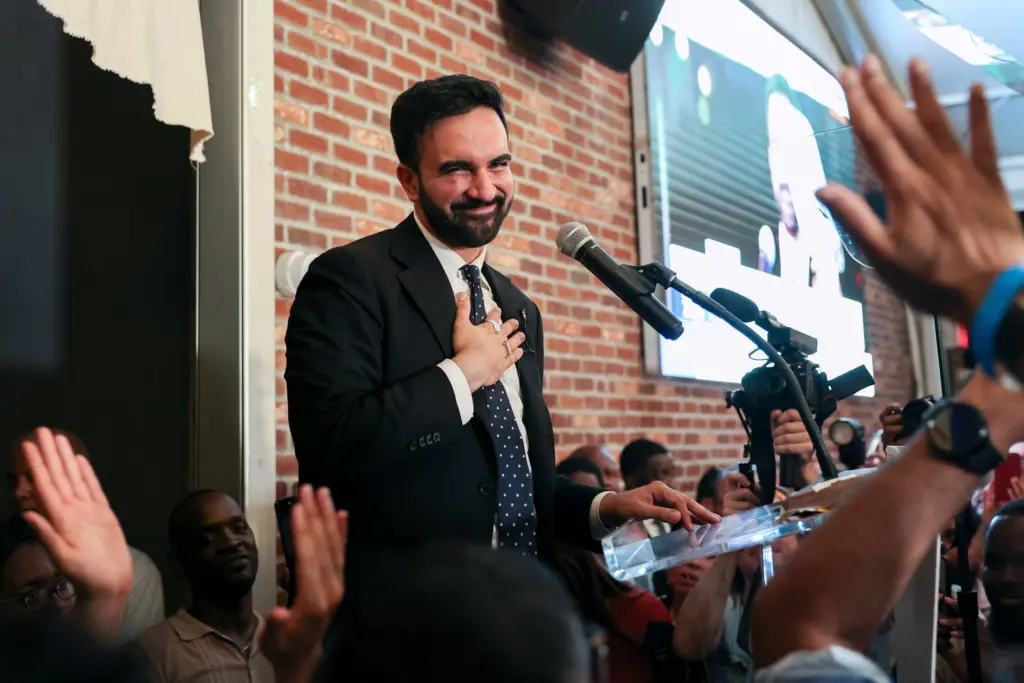
With 50% of the ballots, more than a million votes, Zohran Mamdani became mayor of New York City, the financial capital of the United States. This was a huge victory for a candidate who has publicly spoken out in support of Palestine and who is a member of the Democratic Socialists of America (DSA), the internal tendency of the Democratic Party that advocates for (reformist) socialism and the need for pro-worker policies.
Mamdani, who was a complete unknown to the general public just a year ago, based his campaign on promoting important social measures to make life in the big city “affordable”: freezing rents and standing up to abusive landlords, free daycare, free public transportation, the promise of a wage increase, among others.
Apart from the (deliberately) disruptive nature of his videos and graphics on social media, the decisive factor was his militant tone. He took to the streets and managed to connect, from a positive angle, with younger generations, who flocked to the polls. Voter turnout was the highest since 1969. He raised millions of dollars from small contributions, while 90,000 volunteers joined the campaign with flyers and mass rallies. The local DSA group grew, according to his estimates, to 11,300 members (Jacobin, 11/4).
The election, especially during its final stretch, became “nationalized.” President Donald Trump, whose historical base is New York City, became directly involved in the campaign. He marked former Governor Andrew Cuomo, a very reactionary Democrat who ran outside the party and is facing allegations of sexual abuse and corruption, as “his candidate.” Cuomo received the endorsement of current Mayor Eric Adams, also a Democrat. According to reports, Trump offered him a position in the national administration in exchange for his support (NYT, 10/23). This is just a small sample of the interference from Washington.
Just as important as the political realignments was the pressure and blackmail on the population. Emulating what happened in Argentina, Trump threatened to cut federal funds to New York City if Mamdani won. There are also indications that he could deploy the army or other national repressive forces in New York to ensure the effectiveness of the anti-immigrant unit, something he has already done in all the major cities governed by the opposition.
Big capital, mostly associated with Republicans, the Democratic establishment, and the Zionist lobby, played hardball, even at the individual level. An investigation into official contributors conducted by Forbes (10/27) reports that 26 local millionaires donated $22 million to “independent” groups or platforms that campaigned against Mamdani. The markets received the election cautiously (FT, 11/5).
Trump’s rhetoric of labeling Mamdani a “communist” did not achieve the expected results. It must be said that Trump went even further and associated Mamdani’s face with Democratic candidates in other states where elections were also held, running a smear campaign about the “red danger.” The Republicans were defeated in all the elections.
That being the case, it should be noted that Cuomo made a significant comeback, reaching 41%, and won comfortably in the neighborhoods of the multimillionaires. However, he remains far behind Mamdani in the overall standings. Trump and his entire far-right bloc suffered a severe blow on Tuesday.
The nationalization of the campaign also applies to Mamdani’s side. Although his communication style emphasized his personal image, blurring party logos and affiliations, the apparatus got involved in the campaign. Support from Bernie Sanders and Alexandra Ocasio-Cortez converged with phone calls from former President Obama, who plays a central role in the life of the Democratic Party, as well as backing from the state governor, right-wing Democrat Kathy Hochul, among many others.
The support of the majority party apparatus did not come for free. Mamdani moderated those proposals that could represent a somewhat less veiled confrontation with big capital. Following the governor’s opposition to raising taxes on billionaires, which Mamdani touted as the main source of funding for his social reforms, the current mayor said he had a “plan B” and would cover that amount with fiscal savings in other areas (NYT, 6/10). This was an even vaguer formulation than the original estimates. The proposal for a general wage increase, which already had a flexible framework in the previous period, lost prominence among the central campaign issues in the final stretch.
Mamdani limited his speech to city issues, avoiding new references or statements on Palestine or other important events, such as Trump’s offensive against Venezuela and Colombia. This also extends to a silence regarding the greater threats looming over the city, such as the possibility of deportations and raids against migrants.
Mamdani’s victory is being enthusiastically welcomed by a large majority of workers in New York and other major US cities. It is seen as proof that it is possible to stop Trump and, moreover, that this can be achieved with a “leftist” or redistributive approach, unlike the historical leadership of the Democratic Party, which deepened the economic crisis under Joe Biden and Kamala Harris.
This is leading to a major debate, because it is clear that the Democratic Party leadership is taking note of the political phenomena manifested in Mamdani’s victory and in the social and union mobilizations sweeping the entire country. In the same election, a redistricting plan promoted by California Governor Gavin Newsom was approved. Newsom is emerging as the representative in the presidential election of the traditional Democratic apparatus linked to big capital, as were his neighbors and colleagues Kamala Harris and Nancy Pelosi before him.
The Democratic Party intervenes in these mass popular processes, not to promote them, but to confiscate them politically, prevent ruptures and any hint of class independence, and steer them toward renewed support for one of the dominant lines of imperialism. We are talking about the Democratic Party, the same party that promoted the war in Ukraine, the genocide in Palestine, the massacres in Africa—just to name a few recent examples.
It is a victory that strengthens the internal wing of the DSA that seeks a dispute within the Democratic Party, under the perspective that it can be totally or partially reformed, reorienting itself toward a variant they define as “populist.” The focus, erasing any programmatic element, would be to confront the “candidates of the system” with figures from below. The preeminence of this political current introduces confusion among workers that diverts them from the historical tasks of the class, and must be confronted.
The DSA leadership has not proposed a strategic differentiation from the Democratic Party, but has subordinated itself to its line in the same way that it subordinated itself to the openly anti-worker candidacy of Kamala Harris. The editorial by Eric Blanc, one of its leading theorists, goes very far in this direction and argues that it is a question of “making New York affordable [Mamdani’s slogan] through government action, not market incentives.” (Jacobin, 4/11), which emphasizes the expectation of fiscal measures agreed upon at the top, while erasing the fundamental importance of popular intervention to defend any conquests. This is a huge ideological setback.
Following Mamdani’s victory, the popular movement that supported him and campaigned for him will be subject to all kinds of pressure and even extortion, although this time from the Democratic Party. The tendency for political careerism and to seek positions in the state as an end in itself is the order of the day. The most critical currents on the left of the DSA had less influence than expected at this year’s convention, as a result of the accommodations made after Mamdani’s victory in the Democratic primary. Covering the administration of one of the world’s largest cities, coupled with the expectation of repeating the feat in other elections, will reinforce this pressure. Similarly, the tendency to limit street presence to electoral or symbolic support will also come into play.
The enthusiasm of a million New Yorkers for a platform that declares itself socialist, and the hostility of Trump’s national government, in the midst of a militarizing and fascist offensive, raises the prospect of mass clashes. Revolutionaries must intervene in the political crisis and in these clashes. A fundamental point will be the struggle to impose the popular demands raised by Mamdani, including an immediate wage increase. Nor can the fight with Trump over migrant rights be confined to the city hall. These are tasks to be promoted with campaigns in the unions for a general strike. The militant contribution to the emergence of a trend of workers’ independence will be the path to building a party of the class, leaving behind the historical submission to the imperialist and pro-business Democratic Party.