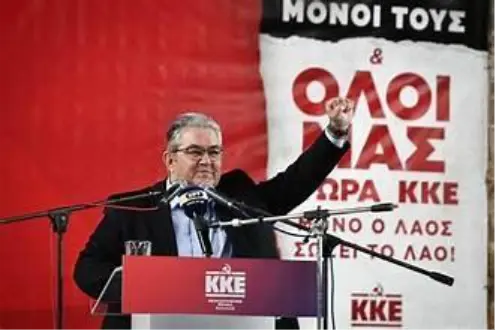
Giorgos Kreasidis, Communist Liberation
The Positions of the Central Committee of the KKE for its 22nd Congress constitute an inward-looking text, with no connection to revolutionary tactics and strategy. Ex-tremely problematic readings of international and domestic reality lead to erroneous conclusions and the rejection of subversive political objectives.
The central slogan, “KKE, strong, steadfast in every test, ready for the call of History for socialism,” is indicative of the spirit of the Positions. Unfortunately, History never “calls” on its own. It is shaped by class struggle and the revolutionary subject in rela-tion to existing conditions.
The compass guiding a communist party’s course is its strategy—that is, the goal of revolutionary transformation of society, opening the road to the socialism/com-munism of our time. But when the path to socialism/communism degenerates, ulti-mately, into an apology for the class-exploitative regimes of “actually existing social-ism” that collapsed, then there can be no strategy of communist transformation ca-pable of opening horizons toward a different, emancipatory society.
The program of the communists is the program of workers’ power and democracy. However, this program acquires concrete expressions and priorities each time, de-pending on the the issues raised by class struggle, and the balance of forces, so that it can become the people’s own, shape the objectives of political struggle, and, through this, concentrate forces for anti-capitalist overthrow and revolution.
None of this exists in the Positions. Along with an erroneous strategy, every notion of revolutionary tactics is absent—even the thought of a dialectical connection between
tactics and strategy. The problem is approached in organizational terms, as a matter of agitation and propaganda, rather than as a question of political line. Characteristically, there is rejection of and polemic against comprehensive political objectives that bring the popular-workers’ movement into rupture with bourgeois politics; acceptance of or compromise with central choices of the Greek state’s international relations (Greek-Turkish relations and their consequences in the region); downgrading of the front against the far right and its ideas; and zero willingness for self-criticism. Thus, no paths of workers’ and popular counter-offensive are opened.
The KKE and international developments
In its opening chapters, the Positions devote extensive attention to the international situation. The assessments of the imperialist character of international antagonisms, as well as the opposition to views that regard China and Russia as “anti-imperialist forces” (views present both domestically and internationally), form a positive basis, although they do not fully illuminate contemporary tendencies of capital’s wars. From this point onward, however, problems begin.
The turn toward war, as the basic—ultimately—method of resolving global imperialist antagonisms, as well as the race of the war economy, is driven by the chariot of West-ern imperialism: the USA, the EU of “Re-arm Europe,” and the United Kingdom. Within imperialist antagonisms, the anti-war front must primarily target the USA–NATO–EU. Especially in a country like Greece, which belongs to the Euro-Atlantic capitalist bloc. Failure to elevate this task as the main one blurs political objectives.
The Positions on the situation in the Middle East are extremely problematic. “The im-perialist character of the war in the Middle East, the bourgeois character of Hamas and of the Palestinian Authority, do not negate the right of struggle of the Palestinian people and the other peoples of the region who resist and fight against foreign occu-pation and other imperialist plans and who, in the framework of struggle, can shape the conditions to definitively disengage from the system of exploitation and wars,” the Positions state.
The contrived vagueness of these formulations is striking. In this region, peoples do not struggle against “foreign occupation” in general, but against the occupation and aggression of the murderous state of Israel—the only one that occupies the territories of other countries. There are no vague “imperialist plans,” but the US-Israeli plan for a “New Middle East,” which includes the subjugation of the Palestinians. There is no “exchange of blows between Israel and Iran–Yemen” (!!), but a unilateral assault by the murderous state of Israel against Iran, Lebanon, Yemen, Syria, and Palestine. The “Israeli invasion of Lebanon” is not due to “Israel’s antagonisms with Arab states” (!), but to its aggressive plans throughout the Middle East. Finally, Hamas is not the same
as the treacherous Palestinian Authority. Such formulations amount to indirect dis-tancing from the Palestinian resistance, at a time when the KKE, in any case, maintains relations only with the Palestinian Authority.
Despite continuous references to a murderous state, its placement as merely “one” of the competing poles in the Middle East—losing sight of the dominant and exclusive role it plays in slaughter and genocide—leads to the absence, in the Positions, of de-nunciation of the Greece–Cyprus–Israel axis under the American baton, and even more so of the need to break it and sever all kinds of relations with the murderous state.
As for the Greek-Turkish antagonism, once again there is a one-sided denunciation of the “unacceptable claims of the Turkish bourgeoisie” (completely forgetting—and fully absolving—the Greek claims over EEZs) in the Aegean and Eastern Mediterra-nean. The KKE aligns itself with the chauvinist narrative regarding the “Muslim minor-ity of Thrace,” denounces the role of the Turkish consulate in Thrace, yet nowhere refers to Greek nationalism or to the nationalist aggressiveness of the Greek state toward minorities within the country.
The struggle against the bourgeoisie’s international relations is a necessary and insep-arable aspect of class struggle against the bourgeoisie as a whole. If you do not chal-lenge the international relations of the Greek bourgeoisie—if you operate largely within the bounds of its central choices (Greek-Turkish antagonism, axis with Israel)—then you lack a line of confrontation; you do not have a class-internationalist line, but a petty-bourgeois line within the bourgeois “patriotic” framework.
Criticism of NATO in Greece is elementary for the Left. What is difficult is challenging, when necessary, the foreign policy and specific pursuits of “our own” bourgeoisie. There, the KKE accepts the “national narrative.”
Tactics, strategy, the movement
It is striking that the Positions include no political program at all, nor any assessment of the KKE’s political proposal for the social “anti-capitalist–anti-monopoly alliance.” The “assessment” concerns not struggles, but the electoral successes of PAME (the front of trade unions controlled by the KKE).
There is a complete lack of elaboration, projection, preparation, and struggle for those political objectives that constitute goals of rupture with dominant policy—ob-jectives that link the fight for immediate interests with the challenge to that policy and the struggle to overthrow it.
While there is an absolute void at the level of an immediate political program, at the level of general rhetoric there is a constant flight toward the “communist future,” sharpening the obvious contradictions of this line. Thus, the KKE’s task in building the social alliance is formulated as follows: “Steps have been taken in understanding that the social alliance is not merely a coordination of various formations created to facil-itate the movement’s advance, but an alliance of social forces in the direction of over-throwing capitalism and building socialism-communism.” The text does not speak of a “strategic perspective,” but of immediate action by the “unions” and “organizations” of the working class and its allies.
Thus, on the one hand, it refuses to integrate objectives such as nationalizations against market liberalization or a rupture with the EU today; on the other hand, it sets as the goal of the “social alliance” the adoption of the overthrow of capitalism and the building of socialism-communism!
The disconnection of (any) tactic from (any) strategy is deafening. “Today, this effort takes the form of expressing solidarity, joint action, and coordination around acute popular problems among the bodies of the various movements.” The Positions do not explain how the leap will be made from “joint action around acute popular problems” to the adoption, by the “bodies of the movements,” of building socialism-communism.
As Lenin said, the masses are convinced through their own experience—not only through the struggle for bread in the workplace, but also through political struggle that goes beyond the immediate sphere of production and embraces the totality of social relations, placing major issues, such as land and peace, as in the period of Oc-tober.
They are not convinced by “ideological lessons” about revolution and communism. These are necessary to elevate the experience of class struggle into revolutionary the-ory. But without experience, they are like a wheel spinning in the air.
When, however, in every broader political confrontation—every clash that goes be-yond the limits of the dominant policy—the KKE, instead of pushing it deeper, turns its back on it in the name of its (usually real) contradictions (December 2008, the 2015 Referendum, etc.), then with what political experience will the people turn toward the “anti-capitalist–anti-monopoly” line?
Overall, the Positions are inward-looking and far removed from the needs of the peo-ple. They chart a steady course of right-wing adaptation both in international relations and in domestic reality. Without a line of intervention, politicization, and radicaliza-tion of struggles—contrary to the, albeit contradictory, radicalization of sections of the people and youth.
When the Tempi movement is “shallow”
The Positions assess (with a strong dose of top-down criticism) that “the broader dis-content expressed in a very mass and militant way in the mobilizations on the occa-sion of the two-year anniversary of the crime at Tempi [the railway disaster in 2023] remains shallow and, to a significant degree, politically limited…,” even that it “failed to mark the transformation of discontent into a comprehensive challenge to the cap-italist system, capitalist property, and the power of capital.”
The KKE sees and mentions nowhere any positive contribution to the radicalization of broader sections of youth and the people, nor to the exertion of pressure on the New Democracy government—only “shallowness” and “limited political horizons.”
Naturally, the KKE recognizes no responsibility for any development of this movement. Once again, every potential crack in the ND government and the system is deemed “insufficient,” denounced as “social-democratic,” and ultimately—usually silently—abandoned to its fate.
Positions on the restructuring of the political system
The Positions refer to the reactionary restructuring of the political system and deal with everything except… New Democracy and the far right! In the relevant chapter, the ND government is dispatched in three lines, without any analysis of its power, the alliances it builds, etc. The focus is placed exclusively on “social democracy” and the emerging “progressive pole.”
There is absolutely no distinct reference to the far right in the Positions, despite it constituting the rising bourgeois political current, nor any separate critique of its pol-itics within its value-cultural framework (nationalism, competition, anti-communism, racism, misogyny, homophobia).
The reactionary restructuring of the bourgeois political system, both in Greece and globally, centrally includes the incorporation of the far right into the official political system, as a lever for intensifying social war and the overall turn toward war capital-ism. Confronting this direction does not mean retreating into “democratic fronts.” On the contrary, its downgrading and the absence of a front from the side of emancipa-tory communist ideas leaves space for all kinds of class-neutralized “democratic fronts.”
Thus, for example, in the Positions on the environment there is reference to EU direc-tions for the “green transition,” but no reference to climate change or to the return of global capitalism—led by the USA—to fossil fuels (a programmatic choice of Trump). At the same time, the Positions continue to evaluate as “positive” the KKE’s stance against the expansion of marriage and parental rights to same-sex couples, without any element of self-criticism and without even opening a discussion