Since February 24, 2022, war has steadily returned to the center of the European continent. Long prepared by the United States and the EU, the war that broke out between NATO and Russia on Ukrainian soil marked the point of no return in the shift of global inter-capitalist conflicts from an economic-commercial to a strategic-military level.
From that moment on, the «necessity» for rearmament—an as rapid and as powerful rearmament as possible—has been on the agenda in Brussels and all European capitals. This has triggered an unstoppable escalation of spending plans. In March of last year, the von der Leyen EU Commission presented the «Rearm Europe» plan, with a total war spending of 800 billion euro. But just a few days ago, the monstrous sum of €800 billion for the production of death was set as five-year target for the sole Germany. In the Germany of untouchable «fiscal austerity,» the Merz government decided to go into colossal debt to double war spending to €183 billion by 2030, and allocated an additional €55 billion for primarily military-related investments in infrastructure (bridges, roads, railways, energy networks). The revision of the Constitution, scrap paper when it becomes an obstacle, was justified by Finance Minister Klingbell, a Social Democrat, as follows: «It’s not possible to defend ourselves from Putin while remaining faithful to the budget dogma.» This flood of billions is already being sold to the public as a lifeline for the tens of thousands of jobs that will be cut in the auto industry due to the transition to electric vehicles and the arrival of Chinese manufacturers.
In turn, indebted France has decided to increase its military budget by 50% by 2030; and is tragicomicly agitating to be the continent’s leading standard-bearer of militarism, with its «coalition of the willing,» Macron’s catchphrases about «blood to be shed,» and NATO-subservient Ukrainian troops marching into Paris. Poland and the Baltic states have placed themselves at the forefront of this process, having already raised their military spending to 4% of GDP and broken all records in Russophobic hysteria.
There are no exceptions. For Italy, the Meloni government — despite its well-known budget difficulties — has sworn allegiance to the decisions of the NATO summit in Ankara, approving the spending items necessary to reach 5% of GDP. With GDP stagnating, military spending is growing at rates exceeding 20%: cuts in social spending are therefore inevitable. In Spain, the double-crosser Sanchez has tripled war spending from 2018 to today (from €11 billion to €35 billion) and has just decided to join the anti-missile «shield» requested by Zelensky. In short, beyond verbal skirmishes and conflicts of interest between European states and between them and the United States, the entire European capitalist world has enlisted in a disastrous race to war and, in the immediate future, for a war economy that will cost blood and tears to the proletariat of Europe and the peoples targeted by European capital, eternally thirsty for profit and massacre.
The inevitable corollary of this process is the repression of the «internal enemy,» with European countries competing to see who can most effectively and methodically repress every form of protest and dissent.
In four years, the Meloni government has enacted seven security packages, creating new crimes, even inventing «word terrorism,» systematically toughening penalties, and imposing harsh legal and judicial penalties on those acting in solidarity with the cause of Palestine’s liberation from Zionist colonialism. The fate of Palestine Action activists in Starmer’s United Kingdom shows that, in this repression, and in the arms and war race that mandates it, there is unity of purpose between the bourgeois right and left. The message from European governments to their real opponents (who don’t sit in parliament but speak out in the streets) was well summarized by Merz: «Defeatists, prophets of doom, grumblers, critics, and professional protesters: get out!» Trump sets the standard here too: we must expel «communists,» «red terrorists,» and «antifa» from society. And we know what that means.
Even the infamous campaigns against the immigrant proletariat by the most extreme right—though they often claim to be «anti-establishment»—serve perfectly as a catalyst for the regimentation and militarization of European societies (from schools to universities, from workplaces to the mass media). Indeed, the immigrant proletariat, here in European countries, embodies the demands for emancipation from poverty and subjugation to Western neocolonialism, which are widely present in Africa, the Middle East, Asia, and Latin America. Within the rush to war, to a new global inter-imperialist war, the age-old need to colonize «peoples of color» and prosper on their backs and their sufferings still pulsates within the ruling class of European countries.
As we internationalists have maintained from the very beginning, the war between NATO and Russia in Ukraine, for what it is and for what it has unleashed, is a war against the Russian and Ukrainian proletarians, and—at the same time—against the proletariat of all countries. It is a horrendous slaughter, for the purposes of domination and not liberation, of Russian, Ukrainian, and other nationalities enlisted to serve either front. It has brought with it a qualitative leap in inter-capitalist competition and conflict, which in turn has led to an intensification of the exploitation of labor and oppression of the working masses. The same goes for the current unbridled arms race, war economy, and war propaganda, which is thoroughly anti-proletarian: both because of its immediate costs (in terms of wage cuts and social spending) and even more so because it aims to pit proletarians against one another, to tear one another to pieces to save their oppressor from the crisis – a decrepit capitalism.
So far, the response of the European proletarian movement, has not been up to the historical challenge. Moreover, for decades, with the exception of moments of awakening and strong combativeness in individual countries and sectors (most notably in Greece and, limited to the logistic sector, in Italy), the organized section of the European proletariat has been on the defensive economically, withdrawing, and convinced that material conditions and established rights can be protected by adopting the policy of the least effort, and it has been almost completely absent from politics and opposition to war. The last few decades have also seen a frenzied bourgeois ideological attack on the working class, with a massive influx of liberalism, chauvinism, racism, and sexism that has occurred without adequate antidotes, and has therefore led to paralysis and disintegration within the ranks of the working class..
The proletarians’ substantial passivity and wait-and-see attitude has undoubtedly been influenced by the pro-rearmament and «pro-Ukraine» and from all the historic socialist, social democratic, and liberal democratic parties, in many cases more warmongering and interventionist than right-wing parties. The positions taken by the historic trade union bureaucracies have also played a role.In this regard, the only positive signal came from the UK Trade Union Congress, which last September approved a motion withdrawing its 2022 support for the British rearmament policy—this, however, without any denunciation of the policies of the UK government, among the most aggressively warmongering in Europe, and with the opposition of the industrial unions. In those same days, the most powerful European union, the DGB, confirmed its support for Germany’s massive rearmament (defined as «defensive»!), albeit deeming the 5% target to be excessive and pretending that you can have both «butter and guns.
The French CGT, the Italian CGIL, the Spanish UGT and CC.OO. are no different. Verbal and demagogic appeals for «peace,» «international law,» «diplomacy,» and the UN, but not a single initiative denouncing their own governments, states, capitalist systems, the EU, or NATO. Indeed, in the case of the UGT and CC.OO., there was a request to the CES to support the actions of the Sánchez government, which vocally declares dissent from Trump’s policies and, in practice, increases war spending. To the contrary, in April 2025, the Spanish CGT called for a halt to the transport of F-15 components to Israel by Maersk through Spanish ports.
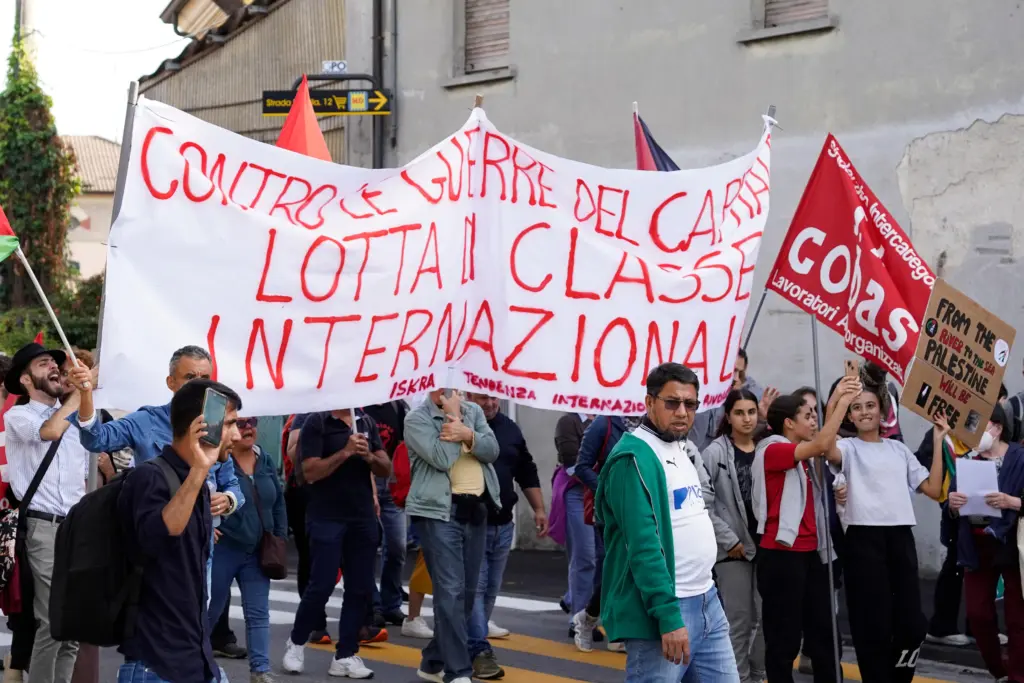
Over the past two years, the proletarian masses have been shaken by the broad and powerful wave of international solidarity against the Zionist genocide sparked by the resistance of the Palestinian people—by far the most significant political movement of the last decade in European countries, and the one with the greatest internationalist potential. In Italy, coming on the heels of countless smaller initiatives and spurred by the Global Sumud Flotilla, last year the weeks from September 22 to October 4 finally saw a political general strike, with hundreds of thousands of proletarians taking to the streets (the slogan being «Block everything»). This strike in addition to grassroots unions involved sectors of the CGIL (Italian General Confederation of Labor), demanding an end to the genocide in Gaza. On February 6th of this year, the 24-hour international strike at European and Mediterranean ports involved around twenty ports in Greece, Italy, France, the Basque Country, Morocco, and Turkey, under the slogan «Dockworkers don’t work for war.» These two very important and successful initiatives, however, have so far failed to truly disrupt the supplies the Zionist extermination machine receives from Europe.
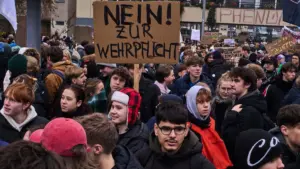
Regarding European rearmament and the race to war, only grassroots unions have organized repeated strikes and street demonstrations in several European countries—but there have also been grassroots unions (Sud Solidaire in France and OZZ IP in Poland) mobilized for supplies in support to the Ukrainian military, despite the clear fact that Zelensky’s Ukraine is a mere executor of NATO’s interests and war plans. Another significant moment of resistance occurred in Germany on December 5, when in 90 cities, starting with Berlin and Hamburg, tens of thousands of young people demonstrated against the reintroduction of military conscription, chanting «Not a single person, not a single cent for the Bundeswehr,» «Up with education, down with weapons,» «We don’t want to become cannon fodder,» «War on war,» and «No to military service for your war»—the beginning of an awareness of the class nature of the wars, both ongoing and in preparation. A second day of mobilization was held in March.
Among the proletarian mass reactions to the war and the new European militarism, perhaps the most significant, albeit totally unorganized, occurred in Ukraine, where—under martial law—there were hundreds of thousands of desertions and escapees from recruitment, thousands of incidents of resistance (sometimes with fire arms) to recruiting gangs, and several demonstrations by wives and mothers of recruits against recruitment centers, with explicit calls for defeatism («Point your guns at those who put them in your hands,» read a banner on a building on the outskirts of Kharkiv). Similar phenomena have also occurred on a smaller scale in Russia, where mass discontent with the consequences of the war appears to be growing alongside the blows the NATO-Kiev axis is managing to inflict on the economy, security, and daily life of Russians, including in both capitals.
We can reasonably predict that over time there will be a broader and more intense mass reaction to the decisions of individual governments, the EU, and NATO, that have a significant impact on the living and working conditions of proletarians. But for significant sectors of workers to shift to the defeatist and internationalist front, we will have to fight against the populist parties of the right and, at times, of the left, which are currently demagogic against European military spending but are ready to push for «sovereign» national rearmament.
The irreplaceable tasks of the vanguard and revolutionary organizations are to rally the struggle against rearmament and the war economy, to connect the responses of the struggle, to sow defeatism and a coherent proletarian internationalism that expects nothing from the camp of states hostile to the West. Theirs is the preparation work for the revolutionary rupture (in a distant future), for the deployment of the organized proletarian masses, which alone can save us from the catastrophe of a new world war between the big capitalist powers of the West and the East.
For this reason, the Athens Conference must issue clear instructions:
Not a man or a penny for capital’s wars!
Down with the war plans of NATO and the EU!
Dissolve NATO, an association of destruction of humankind and nature!
No to the war economy! Allocate the entire military budget to healthcare, education, workplace safety, housing, and the restoration of devastated ecosystems!
International unity of the oppressed and exploited masses against capital’s wars and the police state that works to prepare and sustain them!